JR
JAIMEE ROGERS
Presenter
Journalist
Event MC
Keynote Speaker
Marathon Swimmer

JAIMEE ROGERS:
Jaimee Rogers is a journalist, broadcaster, presenter and MC with more than 15 years’ experience across Australian media, politics and sport.
She currently hosts The Jaimee Rogers Show on News24 every Sunday at 7pm, bringing her experience both inside the media and on the campaign trail to conversations about politics, policy and the issues affecting Australians.
Throughout her media career, Jaimee has worked across News24, Sky Sports Radio, Channel 7 and Channel 10, including as newsreader on The Big Sports Breakfast. She has built a reputation as a confident and engaging communicator who is prepared to ask the hard questions while getting to the heart of a story. Whether on camera, on stage or one-on-one, Jaimee combines curiosity and analysis with an ability to connect with people from all walks of life.
In 2025, Jaimee stepped out of the media and onto the political frontline, standing as a candidate in the Federal Election. The experience gave her a rare perspective on Australian politics — not just as someone who reports on and analyses it, but as someone who has experienced the scrutiny, pressure and realities of a political campaign firsthand.
During the campaign, Jaimee appeared across television and radio, including Sky News, 2GB, 2SM and the ABC, as well as in print media. Working with people from a broad range of backgrounds and political perspectives reinforced her belief in robust but respectful debate and strengthened the independent, analytical approach she now brings to political commentary and interviews.
Outside the studio, Jaimee is passionate about mental fitness and community. In 2022, she swam 35 kilometres across the English Channel, raising $75,000 for mental health charity Gotcha4Life. She continues to support the organisation as an ambassador, helping champion mental fitness programs in schools and communities.
A mum of two young boys, Jaimee’s commitment to mental fitness is deeply personal and remains an important part of her work beyond broadcasting.
Jaimee holds a Bachelor of Sport and Exercise Management and a Master of Business in Marketing.

MC and Keynote Speaker
Jaimee has emceed for Cricket Australia, Sydney Roosters, Race clubs in both NSW and Victoria, The Star, Australian Hotels Association and NSW Business Chamber of Commerce.
As an ambassador for mental health charity, Gotcha4life, Jaimee has presented keynotes on mental health, focusing on resilience and motivation.

CONQUERING THE ENGLISH CHANNEL
WHERE: From Samphire Hoe, UK to Calais, France
DISTANCE: 35kms in a straight line, but the tides make this distance much longer
TEMPERATURE: 15–16ºC
TIME: 12 hours 30 minutes
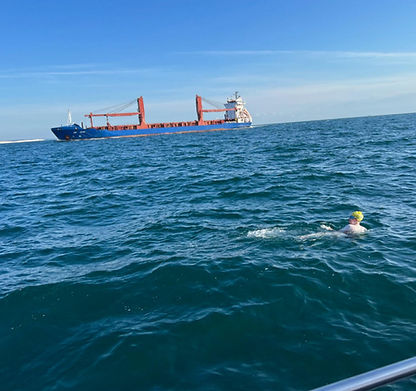
The English Channel would have to be the best known stretch of water in the world and regarded as the Mount Everest of swimming. The 34km stretch of water is one of the busiest shipping lanes in the world. The strong currents, cold water and unpredictable weather make this swim particularly challenging.
When the idea to swim across the channel first came to my mind, I thought it sounded horrendous and not something I wanted to do! I’ve always been a swimmer, but as a breaststroker in the pool, long distance freestyle in the ocean is very, very different. Not one to shy away from a challenge, the more I looked into it, the more excited I got about it.
At the time, COVID had caused lockdowns and people all over the country and world were struggling. It was a time I think many people's mental health was suffering. I decided it seemed fitting to swim the English Channel in support of Gotcha4life, a charity that focuses on Mental Fitness. Ultimately, I proudly raised $75,000 for them.
Surprisingly, the challenges were not all in the water- booking a slot for the swim is the first hurdle to overcome. I booked through the English Channel Association where they have a list of five recommended 'pilots' to use. I confirmed with Peter the Crab- for two years away! There are many options, including 'slots' in given date ranges- My advice to any international swimmer is to try and book in for slot one or two in your tide to minimise the risk of missing out due to bad weather.
Once the swim was booked, my next task was to figure out how to get across! I was recommended to contact English Channel coaching extraordinaire, Vlad Mravec at VladSwim. The VladSwim community is full of swimmers working towards 5kms goals, Ocean 7s or completing the English Channel. It was such a supportive group, happy to share their wealth of knowledge and experience. Vlad wrote my program and I stuck to it religiously.
Training was all consuming: my entire life, my family’s life, and my work life all revolved around this swim. I trained six times a week – four sessions in the pool and one big ocean swim every Saturday that ranged from four to eight hours. To support my swimming, I also did two personal training sessions a week, as well as ice baths, Pilates and stretching whenever I had the time.
During this two-year period, I worked breakfast radio hours meaning I’d start my day at 3:30am and then finish onair by 9:30am. After work, I’d head straight to training which was between two to four hours depending on the schedule. I’d often have double days where I’d swim 6kms in the pool, followed by personal training and stretching. Due to my work hours, I did the pool sessions on my own following Vlad’s program instead of squads. Although the ocean swims were always with the Vlad crew!
My friend, Sarah put her hand up to be support crew, so she’d come out on a Kayak during all of the Saturday long swims. It was a good chance to practice our feeding routine but also so Sarah can learn my swim style and monitor how I’m going in case of any issues in the Channel.
Due to the importance of the conditions for the safety of the swim, a channel crossing is booked as a 'window' rather than a specific date. Because of this, the English Channel swim is also known as the “channel-coaster” due to the ups and downs for a swimmer waiting for their chance to swim. This can change by the minute, hour or day. As a result, swimmers and their crew tend to wait around for go-time, which can be hard mentally not knowing exactly when the swim will happen and poses logistical challenges ensuring that the swimmer is always prepared for the massive feat ahead no matter what time of the day or night!
My window was 2-8 August, and I was swimmer three in my tide. I went over to the UK the week before my scheduled window with Sarah and Corrie who were my support crew along with my pilot and his crew. Sarah and Corrie’s main role on the day was to give me all the nutrients (and various other essentials you might not think about such as mouthwash!) I’d need to complete the swim and keep an eye on me to ensure I was ok throughout.
The big day finally arrived on Saturday August 6, 2022. Surprisingly I was extremely calm. I told myself it was just like any other Saturday swim and stuck to the normal routine I’d do every week. My alarm was set for 1:30am, which would give me plenty of time to stretch and eat a peanut butter and jam sandwich before we set off for the dock. I ended up waking up at 12:45am before the alarm went off feeling refreshed and ready to go.
My swim was scheduled to start at 3am. We needed to be ready to go on the Folkestone dock for a 2:30am pickup ready to set off to Samphire Hoe, which is the official starting beach of the English Channel swim. It’s halfway between Dover and Folkestone and takes about 20 minutes to get there by boat.
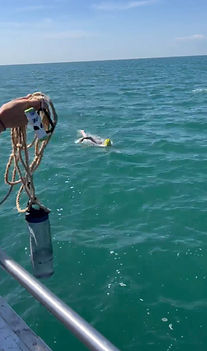
For the swim to officially start, I had to clear water first at Samphire Hoe and then swim back to meet up with the boat. What I wasn’t previously aware of, is that I had to swim this 50m on my own in pitch blackness with no idea where I was going! My pilot, Peter, said to sit on the side of the boat and just jump in! He pointed a flashlight and said to follow the light and that I’ll end up at the beach.
I have the worst sense of direction when I can see, so when I can’t see I was worried I was going off course and not heading towards the beach. I kept putting my head up hoping I was following the dim flashlight. I know 50m should take no more than 45 seconds, and when I felt like I’d been in there longer than that, I did have a moment of panic that I was lost, and my heart rate started to increase. What would I do if I’d gone off course and got lost? Can the boat actually see me? I had a green flashing light on my goggles and swimmers, but there wasn’t any other light around. Literally pitch black..... I did eventually feel the pebbly ground underneath me, meaning I’d made it to the starting point. Time now to turn around and put my hands up to officially start my venture to France!
Starting at 3am meant I’d have approximately two and half hours of swimming in pitch blackness, which didn’t frighten me. This was the way I wanted to start my swim. Firstly, the sun rise over the ocean is absolutely spectacular and something to really take in. I also think mentally, if you start in the dark, it’s like a reset when the sun rises and almost like a new swim is starting. I didn’t think about what was under me in the dark- I was so extremely focused on the end, that nothing else crossed my mind. I had been working towards this goal for two years, nothing was more clear to me other than what I needed to do to achieve this goal.
The water was freezing to begin with. It wasn’t the temperature I was expecting, and I shivered for about three hours. I was getting angry with myself while I was cold that I didn’t do enough ice baths in Sydney (I used to sit in a bath for 45 minutes, three times a week, to get my body acclimatised to the cold. I had had to slowly build up to that 45 minutes, starting with one-minute cold showers).
Cold water training was a vital part of my swimming program due to the English Channel rules of no wetsuits. During winter in Sydney, our Saturday ocean swim was at Brighton Le Sands or Balmoral Beach where the water was around 14 degrees, though some days it was as cold as 12 degrees. The start was always the hardest, it’s like an electric shock up the body when your toe first touches the icy water. We’d get brain freeze so badly when we first got in the water! To overcome the chills during training I used a technique which I then relied on in the channel which was thinking about warm places, like swimming in the Caribbean. This method worked for me- as soon as I snapped out of the trance of being somewhere warm, I realised I wasn’t cold but then the second I became aware of that thought, I’d be cold again!
In the Channel, I swam past enormous jellyfish. I found watching the jellyfish was quit mesmerising, looking at their beautiful colours. Some were electric blue, others had a zebra type print. I also had fun dodging away from them. They were huge compared to anything I’ve seen in Australian waters. Thankfully, I never got stung, which was remarkable considering how many were in the water. However, there were many other challenges, like the deceptive French coastline, which messes with the head.
France starts to look like it’s close when really it’s still at least five hours away. I kept looking up to see if it was any closer and at times it looked like it was further away than the last time! To overcome this battle, I found myself singing and counting a lot. Especially counting my feeds – I thought I was really clever doing this as instructions from coach Vlad included that I wasn’t allowed to know how long I’d been in the water or how far I had to go, to avoid being psyched out... but I was eating every 30 minutes, so I kept track by saying what hour I was up to over and over again in my head to know how long I’d been swimming for! I also yelled “yahoooo” into the water to make myself laugh and random songs, like 'wheels on the bus' from Cocomelon (thanks Archer!) that I’d be singing kept me entertained.
Sarah and Corrie yelled out messages being sent from home when I’d have a quick drink. The original plan was to stop every 45 minutes for a feed, but once I started, we reduced it to every 30 minutes. The feeds consisted of warm pumpkin soup, warm milo, and tailwind on rotation. I also had GU gels that were watered down inside pop tops so it was easy to squirt them in my mouth as well as chocolate and lollies. The feeds had to be quick to ensure I wasn’t wasting time which could be vital at the end. As per English Channel rules, swimmers cant touch anything when stopping, so I’d tread water, quickly eat or drink something, have a laugh with my support crew and then continue on.
With any goal you set, you need to have journey markers along the way to make sure you’re on the right path. I marked hours in my head as points that I’d achieved in training. When I knew it was roughly 5 hours, I told myself that I’d swam 6 hours in training so my body was capable of continuing, then at 8 hours I told myself, "this is what you covered in Cold Camp and in much tougher conditions" than what I was currently facing.
In training, I'd faced adversity which gave me confidence to keep going in the Channel- we had battled enormous waves where we’d be thrown around like rag dolls, strong currents that would separate our group and I’d worry my shoulder would be pulled out of its socket from the bad conditions. I brought these to mind when I needed to put my head down when it got tough.
Three hours out from the finish, I was faced with a challenge that had never presented itself in training. My right shoulder decided it had had enough; every single stroke was beyond excruciating. The channel grease made it very difficult to try and rub out the pain. My fingers would slide all over it and then I’d have nowhere to rub the grease off, other than my swimmers (hence why those swimmers were binned after the swim!). I had strategies to cope, I kept telling myself over and over again that I know a good physio and shoulder surgeon, so even if it meant holding my arm at the end, I wasn’t going to stop!
The second strategy for overcoming adversity in the Channel was printing water bottles with Hudson and Archer’s face on it that were thrown to me. These bottles were made for times during the swim where I was struggling and this was the best time to see those smiling faces. I was also loaded up with lollies and minstrels, which was random as I never had lollies during my training swims, but that was all I wanted in the final stretch to France.
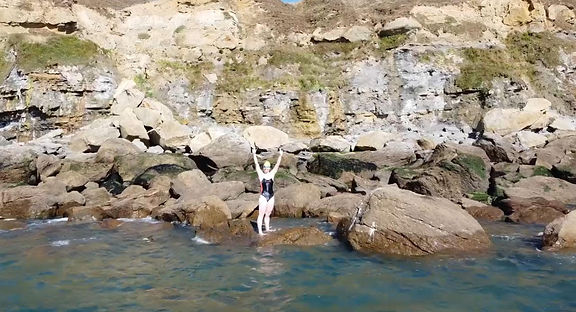
One hour from the finish, Pete the Pilot told me I needed to sprint because the tide is going to change and will add at least another five hours to the swim. He said "put your head down and do not stop until you get to the end!" At this point I knew I needed to dig deep and sprint through the pain and not stop until I got to France, and that is exactly what I did. I finished on the rocks after 12.5 hours. Most swimmers finish on the beach and get the chance to really soak up the moment. Finishing on the rocks meant I had a few minutes to put my arms up to signal I was done and then I was straight into the speedboat to be taken back to the main boat, and back to England.
The boat ride back was 2.5 hours. It was the most incredible journey looking out at the Channel knowing I’d just swam that entire way. But my challenges weren’t completely over. I was only able to sit up right for a brief moment on the boat before feeling really sick that I had to lie down until we were back at Folkestone. The salt water made my voice completely go. I had nothing to eat for about 24 hours and my tongue was so covered in blisters that I couldn’t eat or drink for a week. That’s one of the common things in life, we set these huge goals without realising the toll it has on us both mentally and physically after.
Looking back on the swim I realise how important it is to stop and reflect on the achievement. After dedicating so much time to reach the goal, spend time in that moment and really appreciate what you’ve done before moving on to the next thing. Society is so busy these days, we often are in such a rush to move on to the next thing, we don’t stop and appreciate what we’ve done.
What does this swim have in common with corporate life or day to day life? Click here to read about the lessons learnt from the English Channel.